Suitable
Our advice: have a specialist advise you when you're looking for a well-fitting suit. If you bought your suit in a great hurry at a department store, it often shows. A suit that's too big or too small, or made of inferior quality, simply doesn't look as neat. Here, too, the saying often applies: buying cheap is buying twice. So spend a little more time (money isn't even always necessary) and then benefit from a suit that will last you a long time. When having a suit fitted, you should pay attention to the following points, which are simply looked at from top to bottom:
Which suit fit best suits your body type:
Do you have an average build, or the body of a slim god? Suitable offers both modern slim suits and slim fit, from comfortable to super slim (skinny fit suits). The term "drop" on a suit indicates the ratio of the trousers to the jacket. The most commonly used drops are 6, 7 and 8. Essentially, the higher the number, the slimmer the trousers are compared to the jacket. The number indicates how many inches narrower the waistband of the trousers is than the chest measurement of the jacket.
Drop 4: Found in suits with a roomier fit;
Drop 6: The most common drop and standard in a regular fit;
Drop 7, 7.5 and 8: These drops are used in slim-fit suits.
It's important to know, though, that a drop is not a standardised measurement. Every suit model, from any brand, has its own size specifications. So it may happen that a slim-fit suit already fits very slim in itself, and therefore comes with an even slimmer pair of trousers. For specific advice, you can always turn to one of our advisers in the stores.
How should a suit fit?
A lot goes into a well-fitting suit. But how should a suit fit? Below we explain what to look out for. Pay attention to the shoulders, for example: if it's too wide or too tight here, it quickly looks cheap. Other important points are the back, the waist and the length of the trousers.
How should the shoulders of your suit fit?
The golden rule: the shoulders of the suit must not overhang your own shoulders. A suit is built up from the shoulders, so never simply have them altered. Only a few specialists in the Netherlands know how to handle this. If the shoulder doesn't fit, try a different size or shape; we'll be happy to help you with that.
About the back panel of the suit
You may not see it yourself, but a well-fitting back is hugely important for the appearance of your suit. In principle, the back should run smoothly, with a little bit of ease at the bottom of the arm to leave some freedom of movement. If there's too much fabric at the top, a good tailor can pinch it in under the collar. If there's too much room at the bottom, the back panel can be taken in. Although 'slim' is the trend, the vents at the back are not meant to stand open. If they do, the panel is too tight.
The back collar of the suit
The collar should sit neatly against the neck. Do make sure you pull the jacket properly over the shoulder and settle the collar into the neck. If the collar doesn't sit well, it's better to switch to a different model.
How should it fit at your waist?
The waist of the suit jacket should also fit neatly and, in line with the trend, just not pull at the button. Etiquette teaches us that you should wear your jacket closed at various moments: at a first introduction, during a speech and when making an entrance. After that, to open yourself up more in communication, you undo the button (with a two-button, only the top button closed) straight away. The waist must fit your body neatly both when closed and when open. Adjustments can, if necessary, easily be made by taking in the waist seams. Incidentally, at Suitable we prefer a double vent to improve the fit and comfort. The so-called centre vent (a vent in the middle) is harder to fit, so it will more often stand open. No vent is not an option. Jacket too tight? Because there's always 2 centimetres of spare fabric at the waist seams, a blazer can be let out.
Are the sleeves long enough?
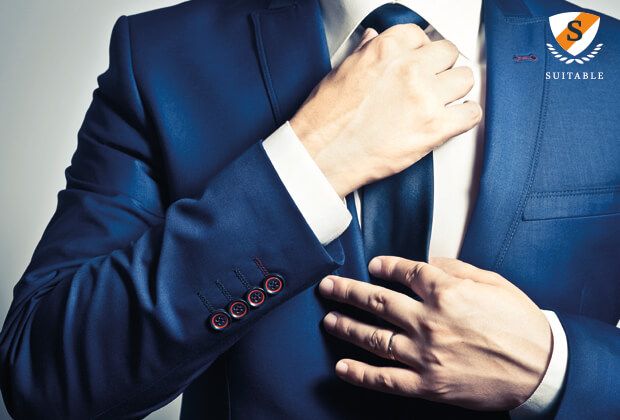
The sleeve length of a suit or blazer is assessed with a relaxed, hanging arm. The sleeve then ends at the base of the ball of the thumb. The shirt should then extend about 1 to 1.5 cm below the sleeve. The length can be adjusted if necessary, depending on the position of the buttons and any fabric present on the inside. Besides the sleeve length, also pay attention to the width of the sleeve and how the arm is set in. If there's too much tension against the armpit, it's not comfortable to wear. If you're blessed with larger upper arms (biceps), you'll also need to feel whether the sleeve isn't too tight.
Suit trousers
You generally wear the trousers of your suit the most. So it's important that they fit really well. The waist of the trousers should already be ideal without a belt; you should really see the belt as an accessory, not as an aid to keep your trousers up. You can easily see whether the trousers fit properly by checking that the seat is neatly close-fitting (must not sag) and that the pockets don't gape outwards but fall closed tightly. Trousers too tight? The trousers can be adjusted by giving the waistband more room. With some suits, the trousers can also be ordered separately, so you can alternate between several pairs of trousers. Such as the trousers of the Evans suit.
Length and width of your trousers
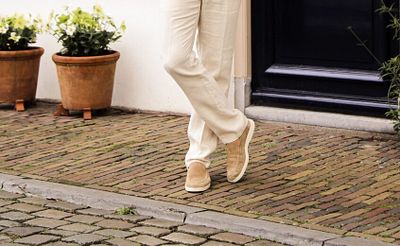
The length of the trousers is debatable, but our preference is halfway down the heel, because the shoe then comes into its own much better. At Suitable we have a wide collection of men's shoes suitable for wearing under a suit. Incidentally, Jort Kelder set the trend years ago with ankle-length trousers. Apart from a few Italians, we still don't see this as commonplace in the Netherlands (but it is hip!). Besides the length, take a look in the mirror at the width of the leg. On the one hand, it must remain comfortable to sit down in the trousers; on the other hand, you can't get away with an excess of fabric on the leg these days. We're happy to adjust the trousers to your personal preference with fitting advice on the use of the suit. At Suitable we're convinced that, through good advice as described above, we can make an off-the-peg suit fit like a made-to-measure suit. We'd be delighted to welcome you to the Suitable Shops for personal advice.